
A 24-hour general strike has been called for Wednesday, 11 November, to demand the right to decent housing and wages that make a decent life possible. CGT-CELLS explains the reasons behind the strike, its main demands and answers some of the most common questions about taking part.
Dear colleagues,
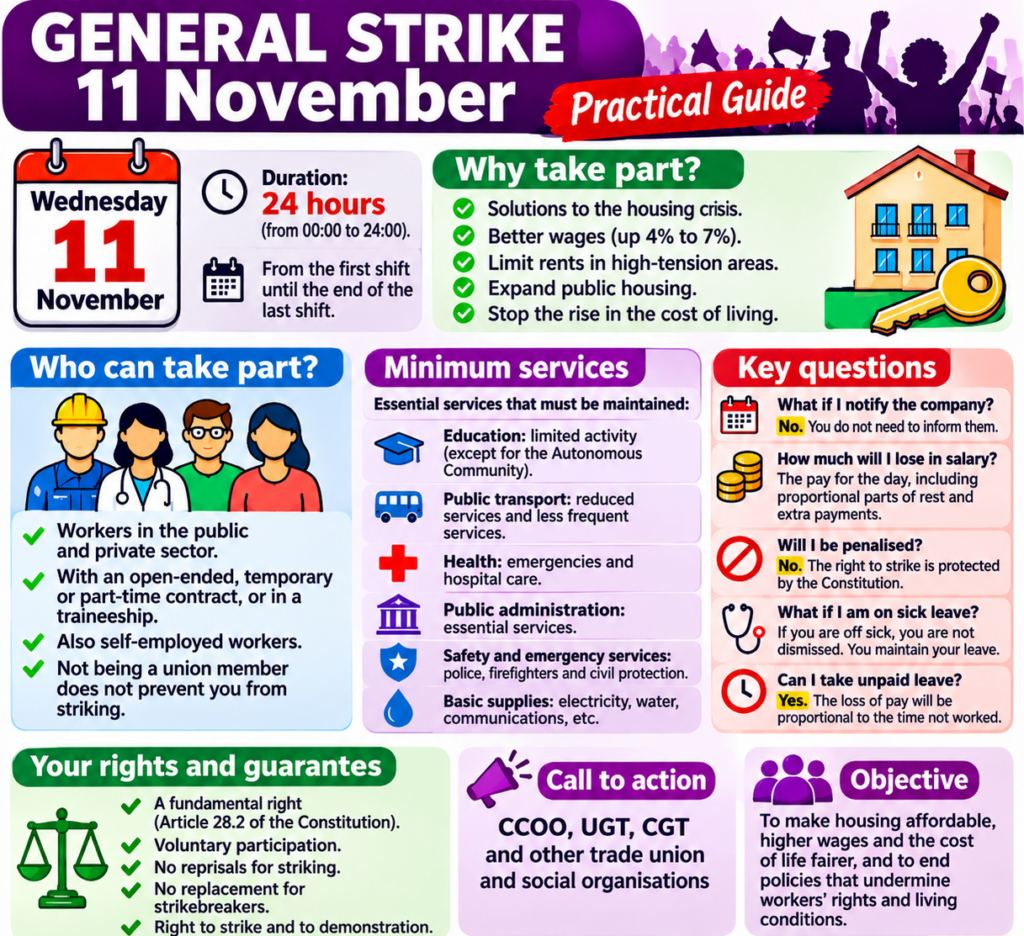
As you already know, a 24-hour nationwide general strike has been called across Spain for tomorrow, Wednesday 11 November. The call brings together CGT, CCOO, UGT, CNT, Comisiones de Base, Solidaridad Obrera, the Confederación Intersindical, Intersindical Alternativa de Catalunya, Intersindical Valenciana and the Union of Actors and Actresses, together with the Confederation of Tenants’ Unions.
The mobilisation responds to the difficulties people face in accessing housing and the rising cost of living in Spain. The organisations behind the strike argue that wages are no longer enough to cover these expenses and are calling for measures against abusive rents, speculation and evictions where no alternative housing is provided. The strike also includes labour-related demands: higher wages, the recovery of purchasing power, shorter working hours and stronger social rights. It is therefore intended as a general mobilisation linking the housing crisis with our working and living conditions.
From the CGT-CELLS trade union section, we want to share the main reasons behind the strike and answer some of the most common questions about taking part:
What does housing have to do with our working conditions?
Access to decent housing is a basic need for everyone. But housing has become a luxury. Prices have risen by 33% since 2021 and by 88% over the last ten years, while our wages have nowhere near kept pace. Finding somewhere to live is becoming increasingly difficult, even for people who have a job. Every pay rise we secure through collective bargaining is swallowed up by the landlord before we can feel its effects.
That is why fighting for decent wages and affordable housing go hand in hand. There is little point in earning more if we have to spend an ever-increasing share of our income just to keep a roof over our heads.
What are the demands regarding housing?
The main demands are:
- Reduce rents and introduce effective limits on rental prices.
- Regulate short-term and room rentals to prevent them being used to circumvent those limits.
- Make open-ended rental contracts the default.
- Expand public housing by recovering and expropriating properties held by vulture funds and speculators, and remove their tax privileges.
- Stop evictions where no decent alternative housing is available, especially for people in vulnerable situations.
What are the demands regarding wages and working conditions?
The strike calls for wage increases that restore purchasing power and protect workers against inflation, a minimum wage and minimum pension of €1,500 per month, and a 35-hour working week with no reduction in pay.
The campaign’s position paper also proposes introducing wage guarantee clauses and negotiating additional payments to help cover housing costs. It also calls for the repeal of the Gag Law and rejects pressure on workers to work while on sick leave.
Why call a general strike? Can stopping work for one day really make a difference?
Absolutely. A strike is one of the most powerful tools of collective pressure available to workers. By stopping our work together, we show that our labour is what keeps the economy and society running. Disrupting production and services creates economic, social and political pressure for our demands to be heard. The greater the participation, the stronger our position when negotiating and demanding change.
Many of the labour rights we now take for granted were won through strikes and collective action. In Spain, the 1919 La Canadiense strike played a decisive role in securing the eight-hour working day. In France, the major strikes of 1936 helped bring about advances such as paid holidays and stronger collective bargaining.
One day of striking will not solve all these problems on its own, but it can strengthen our demands, build collective organisation and increase pressure for meaningful responses. A strike is not an end in itself, but another step in the struggle.
Can I go on strike if I am not a union member or if I have a temporary contract?
Yes. Any worker covered by the strike call can take part, regardless of whether they belong to a trade union. Having a temporary contract or being in a probationary period does not take away this right either.
Do I have to notify the company in advance?
No. You are not required to inform the company in advance that you intend to take part in the strike. The legal notice for this general strike is the responsibility of the trade unions calling it, and they have already submitted it.
Can I be disciplined or punished for taking part in the strike?
No. The right to strike is a fundamental right, recognised in Article 28.2 of the Spanish Constitution, and its legitimate exercise cannot be grounds for any kind of disciplinary action. If you receive pressure or threats, contact any workers’ representative as soon as possible.
How much pay will I lose?
You will lose the salary corresponding to that day, including the proportional amounts for weekly rest and extra payments. Your holiday entitlement is not affected. You will not make Social Security contributions for that day, but you will remain registered under the special-status arrangement applicable during a strike.
To put it into perspective: on an average salary, people work around ten days a month just to pay their rent. The strike costs one day.
I already own a home.
The strike also addresses inflation, wages and working time. Moreover, difficulties accessing housing affect our relatives, friends and colleagues. Defending affordable housing means defending decent living conditions for society as a whole.
“What we need to do is build more homes.”
In many places, there are already more than enough homes; the problem is how they are being used, although in other areas building more may indeed be necessary. But regardless of whether more homes are built, if housing continues to be treated as a commodity, the problem will not be solved. Between 2000 and 2008, just over four million homes were built in Spain. Prices multiplied, and the subsequent crisis left millions of working people without jobs or homes.
“Small landlords also have the right to make a living.”
Nobody should have the right to make a living at the expense of other people’s work. Housing should be a guaranteed basic good: that is the only way to make it a real right, while the right to speculate should not exist. In any case, this strike targets banks, large property owners, investment funds and the governments and public authorities that serve their interests.
You can read the full CGT Catalunya position paper here.
CGT-CELLS encourages you to join tomorrow’s strike. Our work should allow us to live with dignity.
Let’s make ourselves heard on 11 November!
CGT-CELLS Trade Union Section